Industrial incidents are rarely explained by the camera alone. The physical view may show a conveyor stopping, a line backing up, or an operator walking to a station, but the real cause is often on the screen: an alarm banner, a threshold crossing, an acknowledgement, a parameter change, or an HMI state that existed for only a few seconds.
That is why SCADA and HMI recording has real value in manufacturing and critical infrastructure. It preserves process context that is usually missing when teams review only the camera footage.
DeskCamera fits this workflow because it can expose selected Windows-based operator screens to the surveillance platform over ONVIF and RTSP instead of sending investigators to a separate workstation-recording tool.
Before teams move to this model, they often rely on awkward workarounds: a hardware encoder on the operator station, a camera aimed at a monitor or scale display, text-based SCADA logging that misses the operator view, or a custom capture script that becomes hard to maintain on multi-monitor consoles.
Where SCADA and HMI Recording Pays Off
Teams usually need this when they want to:
- record an HMI or SCADA screen in the VMS
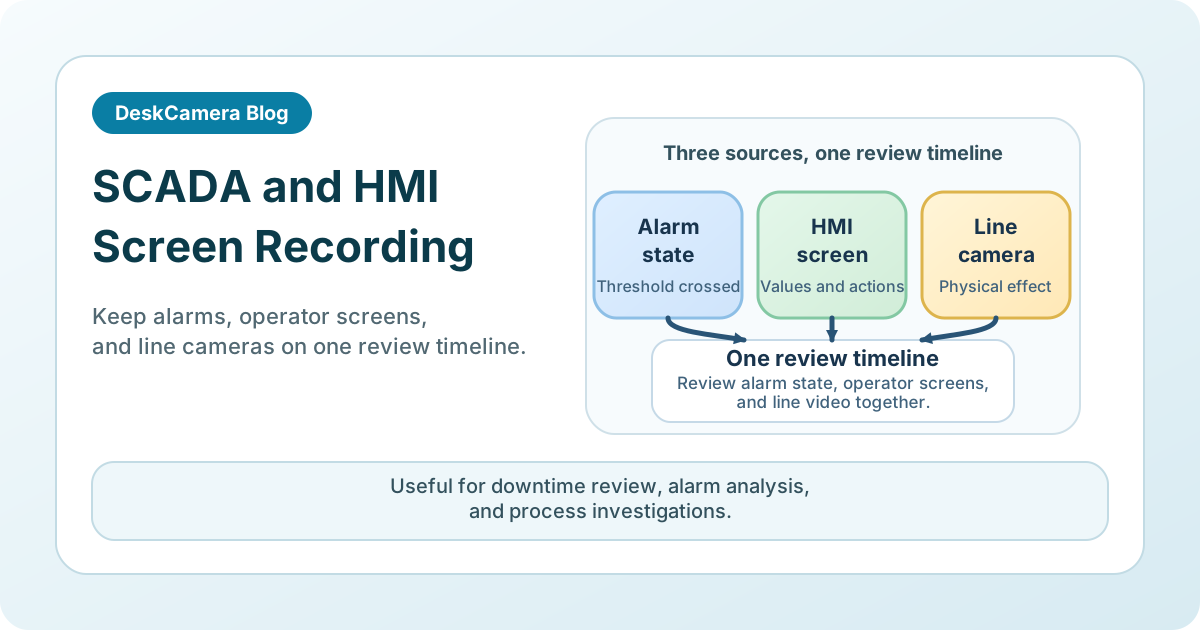
- review operator actions and line video on one timeline
- investigate alarms, downtime, or process deviations with both screen and camera evidence
That is a much narrower and more operational use case than generic screen capture.
Workflow 1: Alarm-to-Response Reconstruction
A strong manufacturing use case starts with an alarm or abnormal process condition.
A line camera may show the physical effect, but the review team also needs the operator interface. They may need to confirm:
- when the alarm first appeared
- what values or states were visible on the HMI
- when the operator acknowledged the condition
- how quickly the physical process changed after the on-screen event
When the HMI screen and the line camera sit on the same timeline, downtime and incident reviews become much easier. Teams do not have to align screenshots, operator notes, and exported video by hand.
Workflow 2: Changeover, Procedure, and Exception Review
Screen recording is also useful when the issue is not a single alarm but a process deviation during normal operations.
Examples include a changeover, a recipe adjustment, a restart after stoppage, or a repeated exception that operators handle differently across shifts. In those cases, investigators often need both views:
- the operator workflow on the screen
- the physical effect on the machine, room, or line camera
That makes the deployment useful for downtime analysis, procedure review, and post-incident coaching, not only for rare critical alarms.
Real Industrial Deployments
- BALTIC COAL TERMINAL JSC records multiple Siemens SCADA operator monitors 24/7 for abnormal-situation analysis and human-factor review.
- Fiskarhedens Trävaru AB captures production-application screens on Windows PCs and records them via ONVIF on NVRs, so operators can review screens and cameras together even when the PC is elsewhere.
- E-MAX PROFILES GULLGEM records production screens next to machine footage to improve quality review.
In each case, the line camera shows the physical outcome while the operator screen shows the alarm state, control action, or production condition that explains what happened.
The same model fits control HMIs, optimizer GUIs, weighing-station displays, and other production screens that are hard to review later with a camera or text logs alone.
If you need the general implementation model first, see How to Record a Computer Screen to a VMS .
If your operator workflow is closer to dispatch and public-camera review than line control, see command center screen recording for city operations .
Operational Considerations Before an OT Rollout
OT workstations are not standard office endpoints. A credible deployment has to respect that.
Change control on real production systems
Any pilot should be tested on the actual operator station image, hardware, and support model used in production. Lab success on a non-critical PC is not enough.
Legacy host constraints
Some industrial deployments still depend on older Windows builds or tightly controlled operator images. That makes early host validation important: the exact graphics stack, restart behavior, and support model on the production station matter more than a clean demo on a modern office PC.
Readable playback of dense interfaces
HMIs and SCADA screens can contain small values, alarm lists, and color-coded states. Review quality should be tested against real incidents: can the team actually read what mattered later?
Network and segmentation fit
Many industrial environments separate OT networks carefully. The recording design, stream path, and VMS reachability need to respect that segmentation from the start.
Fail-safe operational behavior
Teams should validate startup behavior, service recovery, and resource impact so the recording layer does not interfere with operator responsibilities.
Why Teams Keep HMI Review Inside the VMS
Manufacturing and critical infrastructure teams usually want one review workflow, not another silo. When the HMI behaves like another managed video source in the surveillance platform, supervisors can compare alarms, operator response, and physical outcome in one place.
That avoids a separate archive of desktop recordings that operations and security teams have to retrieve and align manually.
If you want the workstation-to-device model behind that workflow, read Can a PC Act as an ONVIF IP Camera? .
Start with One Console Tied to an Existing Review Process
A practical pilot usually starts with one HMI or SCADA station that already matters during downtime review, alarm analysis, or post-incident meetings. That gives the team a narrow way to validate readability, host impact, segmentation, and retention before expanding to more consoles.
If you want to see how DeskCamera fits industrial and critical-infrastructure surveillance workflows, review the DeskCamera manufacturing page . Then start a free trial for one HMI or SCADA station and confirm playback readability, host impact, and recovery behavior on the real operator workstation before expanding.